

ISO 14064 vs GHG Protocol: Which Standard Should Your Business Use?
Learn the differences between ISO 14064 and the GHG Protocol, and discover which greenhouse gas accounting framework is best suited for your organisation's reporting needs.
As businesses face increasing pressure to understand and manage their greenhouse gas (GHG) emissions, two frameworks are frequently mentioned: ISO 14064 and the GHG Protocol. While both are widely recognised and share many similarities, they serve slightly different purposes.
Understanding the differences can help organisations select the most appropriate approach for carbon accounting and reporting.
What is the GHG Protocol?
The GHG Protocol is the world's most widely used greenhouse gas accounting framework. Developed by the World Resources Institute (WRI) and the World Business Council for Sustainable Development (WBCSD), it provides guidance for organisations to quantify and report greenhouse gas emissions.
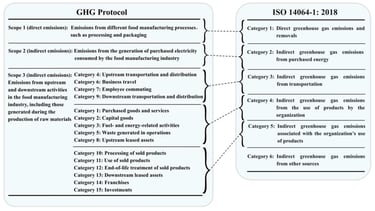
The GHG Protocol introduced the commonly used classification of:
Scope 1: Direct emissions from owned or controlled sources.
Scope 2: Indirect emissions from purchased electricity, steam, heating, or cooling.
Scope 3: Other indirect emissions occurring throughout the value chain.
Today, many sustainability reporting frameworks, disclosure platforms, and corporate reporting requirements reference the GHG Protocol.
What is ISO 14064?
ISO 14064 is an international standard developed by the International Organization for Standardization (ISO) for greenhouse gas quantification, reporting, and verification.
The standard consists of several parts, with ISO 14064-1 focusing on organisational greenhouse gas inventories and reporting. It provides requirements and guidance for:
Defining organisational and reporting boundaries.
Quantifying greenhouse gas emissions and removals.
Managing data quality.
Reporting greenhouse gas inventories.
Supporting independent verification and assurance.
ISO 14064 is commonly used when organisations require a structured and auditable greenhouse gas inventory.
Similarities Between ISO 14064 and GHG Protocol
In practice, both frameworks are highly aligned and often produce very similar greenhouse gas inventories.
Both frameworks:
Require identification of organisational boundaries.
Categorise emissions into direct and indirect sources.
Encourage transparency and documentation.
Promote completeness, consistency, accuracy, and relevance.
Support credible greenhouse gas reporting.
As a result, many organisations can satisfy both frameworks through a single carbon accounting exercise
Key
Differences
Which One Should You Choose?
For most organisations, the answer is not necessarily one or the other.
If your goal is to meet sustainability reporting requirements, investor expectations, or customer requests, the GHG Protocol is often the preferred reference framework.
If your organisation requires a structured inventory that may undergo independent verification or assurance, ISO 14064 provides a strong foundation.
In many cases, organisations develop their greenhouse gas inventories using GHG Protocol principles while ensuring alignment with ISO 14064 requirements. This approach provides flexibility, credibility, and verification readiness.
The Practical Reality
The quality of a greenhouse gas inventory depends less on the framework selected and more on the quality of data, assumptions, emission factors, and documentation used during the assessment.
Whether following ISO 14064 or the GHG Protocol, organisations should focus on establishing clear boundaries, maintaining reliable records, and applying transparent calculation methodologies.
Conclusion
ISO 14064 and the GHG Protocol are complementary rather than competing frameworks. Both help organisations understand, quantify, and communicate their greenhouse gas emissions.
For businesses beginning their carbon management journey, selecting a framework is important—but building a reliable and evidence-based emissions inventory is even more critical.
At Bumi Carbon, we help organisations develop practical greenhouse gas inventories aligned with recognised international frameworks, supporting reporting requirements, customer expectations, and future decarbonisation initiatives.
Get in touch
Support@bumicarbon.com